
Allegations Mount Over Arms Flows to Sudan’s RSF via Kenya as El Fasher Falls
Sudan’s army-backed government has accused Kenya of serving as a transit hub for weapons destined for the Rapid Support Forces (RSF), allegations Nairobi strongly denies. The claims have intensified following the RSF’s siege and capture of El Fasher in Darfur, raising regional and international concerns over arms embargo violations.
KENYA
Emmanuel Makome
1/4/20263 min read

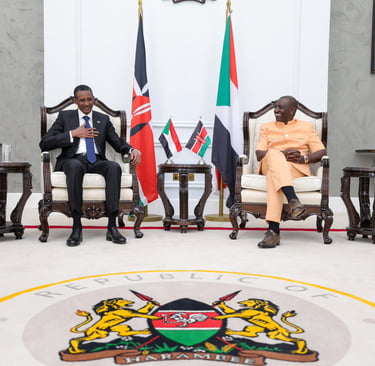
Accusations That Kenya Is Supplying the RSF
Sudan’s government has formally accused Kenya of acting as a conduit for weapons supplied to the RSF, allegedly originating from the United Arab Emirates (UAE). The Sudanese Foreign Ministry says arms and ammunition bearing Kenyan labels were discovered in RSF weapons caches in Khartoum and Omdurman.
According to Sudanese officials, the recovered crates were marked with Kenyan Ministry of Defence–linked identifiers, including references such as “CONTRACT NO.23PTI / KEMOD-01 / KENYA” and “AMI/KEN/099/2023.” Khartoum argues these markings indicate at least indirect Kenyan involvement in the RSF’s supply chain.
Investigations and Transit Routes
A six-month investigation by Kenya’s Daily Nation alleged that Kenyan airports—particularly Moi International Airport in Mombasa—have been used as transit points for suspected arms shipments bound for the RSF. The investigation cited a UN Security Council report from January 2024 that identified Kenyan airports as potential nodes in RSF logistics networks.
The alleged routes involve weapons moving from Abu Dhabi to Chad, before being transferred onward through a network that includes Kenya, Rwanda, and Uganda, eventually reaching RSF-controlled areas in Sudan.
How the Weapons Allegedly Reach Sudan
Analysts and investigators say weapons are shipped from the UAE into Chad and then flown or transported by road into Sudan through neighboring countries. Kenyan airports are described as logistical hubs in this network rather than final destinations.
One cargo aircraft—an Ilyushin Il-76—was reportedly observed at Mombasa airport in March 2024. This aircraft type has frequently been linked to arms transfers in conflict zones. Reports also claim that some private or military-style cargo flights used to supply the RSF were piloted by Kenyan nationals.
In one widely cited incident, a Kenyan pilot, Michael George Oluoch Nyamodi, was reportedly flying a cargo aircraft carrying RSF supplies when it was bombed by Sudanese Armed Forces in Nyala, South Darfur, in early May 2025.
Link to the Siege and Fall of El Fasher
El Fasher, the capital of North Darfur, endured an 18-month siege by the RSF before falling in late October 2025. During the siege, the RSF used heavy weapons, mortars, and drones to bombard the city, cut supply lines, and restrict civilian movement, contributing to a major humanitarian catastrophe.
UN experts and regional analysts argue that the RSF’s ability to sustain such a prolonged siege depended on steady external supply lines delivering weapons, ammunition, fuel, and drones. These supplies are believed to originate mainly from the UAE, Libya via Khalifa Haftar’s forces, and Wagner Group–linked networks, using transit routes through Chad, South Sudan, and Kenya.
The types of weapons reportedly found in RSF caches—such as 14.5×114 mm anti-material rounds and 82 mm mortar bombs—match munitions used in Darfur, including around El Fasher, reinforcing claims that arms moving through regional hubs ultimately reached RSF fronts in western Sudan.
Kenya’s Official Position
The Kenyan government has firmly denied supplying weapons to the RSF. Officials say the crates and markings shown in Sudanese footage do not correspond to legitimate Kenyan military exports and insist that all production from the Kenya Ordnance Factory is strictly audited and accounted for.
Nairobi maintains that it is acting as a neutral mediator in the Sudan conflict, highlighting its role in hosting peace-related engagements, including meetings in Nairobi involving RSF leader Mohamed Hamdan Dagalo (Hemedti) and regional actors.
Sudan, however, has rejected this stance, responding by banning Kenyan tea imports and recalling its ambassador, accusing Kenya of undermining Sudanese sovereignty by providing diplomatic space to RSF-linked figures.
International Concerns and Possible Consequences
The allegations have drawn concern from the United Nations, the United States, and the African Union. International actors have warned that any form of state support—direct or indirect—for the RSF risks undermining peace efforts and may violate existing arms embargoes on Sudan.
U.S. officials have signaled that, should evidence emerge confirming Kenya’s facilitation of arms flows to the RSF, it could lead to sanctions or reductions in diplomatic and aid cooperation. As investigations continue, Kenya finds itself under growing regional and international scrutiny amid one of Africa’s most devastating conflicts.
Photo: William Ruto / X
MORE NEWS
© 2026. Ke Press Global. A Ke Harbor Company. All rights reserved.
FOLLOW KE PRESS GLOBAL ON :
Contact us